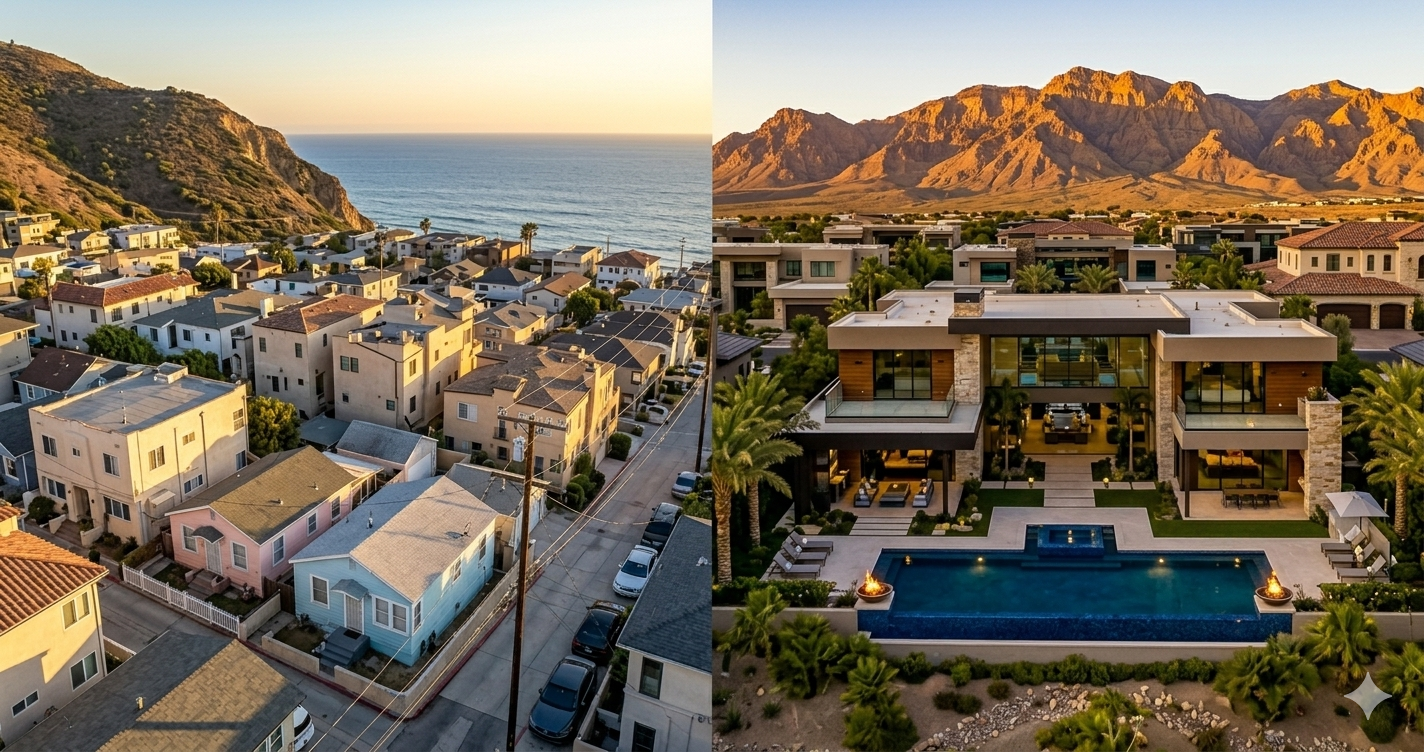
The gap is wider than most Californians realize — and it’s getting wider.
There’s a conversation I’ve had at least a dozen times in the last six months. It usually starts the same way: a California homeowner — La Jolla, Newport Beach, Manhattan Beach, Palo Alto, Tiburon — mid-fifties, successful career, calls to ask what it would actually look like to sell and move to Las Vegas. Somewhere around minute four, they ask the question every California relocator eventually asks.
“What does my house get me over there?”
That’s the question this piece answers — specifically at the $2.2 million price point, because that’s where most of my relocation conversations are happening right now. It’s the sweet spot where California families have real equity to move and Vegas offers a genuinely different life, not just a cheaper version of the same one.
To make the comparison concrete, I’ll use La Jolla as the California example. The same math works with minor variations in every premium coastal or Bay Area market. Substitute your own zip code and the story rhymes.
$2.2M in a California luxury market: the entry-level tier
In La Jolla, $2.2 million is not a luxury budget. It’s an entry point.
The median single-family sale price in La Jolla in 2025 was roughly $3.2 million, and it’s been trending upward every year since 2020. At $2.2M, you are shopping below the median — which in coastal San Diego means you’re looking at one of three realities:
- A smaller footprint. Think 1,800–2,400 square feet, often a mid-century home that hasn’t been fully updated. Three bedrooms, two baths is typical. The lot is modest, the kitchen is likely original or lightly refreshed, and the ocean view — if there is one — is partial.
- A townhome or condo in a coveted pocket. A 3-bed/2-bath townhome with skylights and a peek of the Pacific, HOA included. Lock-and-leave, which has its own appeal, but you’re sharing walls.
- A fixer with potential. The “remarkable investment opportunity” listings — the 2-bed, 1-bath bungalows with a detached garage and a plan to add square footage. You’re buying the dirt and the zip code.
The pattern repeats in every premium California market. In Newport Beach or Manhattan Beach, $2.2M buys you a mid-tier home a few blocks off the water. In Palo Alto or Menlo Park, it’s a modest 1960s ranch on a small lot that will need work. In Tiburon or Mill Valley, it’s a dated split-level with a partial bay view.
None of these are bad homes. The walkability, the coastline or the tech-hub proximity, the cachet — those are priced in, and they’re real. But at $2.2M in premium California, you are buying the neighborhood, not the house.
$2.2M in Summerlin: the luxury tier
Now move the same $2.2 million budget to Summerlin, and the conversation changes completely.
$2.2M in Summerlin puts you firmly in the upper tier of a 22,500-acre master-planned community that’s been developing for over 36 years. The median Summerlin sale price in 2026 is around $686,000. At $2.2M, you are shopping at roughly 3.2x the median — the inverse of the California math.
Here’s what that actually looks like:
- 4,000–5,000+ square feet of new or near-new construction. Desert contemporary architecture, 10-to-12-foot ceilings, disappearing glass walls to the backyard.
- Four to six bedrooms, a dedicated office, a media room, a gym. The floor plans assume you work from home, entertain, and have extended family visiting.
- A guard-gated community — The Ridges, Red Rock Country Club, Tournament Hills, or one of the newer Summerlin West villages. Direct views of Red Rock Canyon in many cases.
- A backyard built for the desert. Pool, spa, covered outdoor kitchen, fire features. Roughly 294 days of sunshine a year to use them.
- Golf, tennis, and private club access depending on the community — Tom Fazio, Arnold Palmer, and TPC courses within the master plan.
This isn’t a downgrade. For most California relocators at this price point, it’s the first time they’ve ever owned a home that feels like the homes they grew up looking at in magazines.
The numbers underneath
The price-per-square-foot comparison tells the story cleanly, using La Jolla as the California reference point.
| La Jolla (reference) | Summerlin | |
|---|---|---|
| 2025 median sale price | ~$3.2M | ~$686K |
| Typical $2.2M home size | 1,800–2,400 sq ft | 4,000–5,000 sq ft |
| Approx. price per sq ft at $2.2M | $900–$1,200+ | $450–$550 |
| Lot size | Often under 0.15 acre | Commonly 0.25–0.5+ acre |
| State income tax | Up to 13.3% | 0% |
| Property tax rate | ~1.1% | ~0.5–0.6% |
The per-square-foot differential runs roughly 2x across most premium California markets. Newport Beach, Manhattan Beach, Palo Alto, and Tiburon all sit in the $1,000–$1,500/sq ft range at comparable price points. Summerlin’s upper tier sits in the $450–$550 range.
For a California family earning $500K, the state income tax difference alone is roughly $65,000 per year. Over a ten-year hold, that’s $650,000 — more than enough to cover the delta on upgrading from a California entry-level luxury home to a Summerlin estate, with six figures left over.
That’s before you account for Nevada’s lower property tax rate on a lower purchase price, or the fact that Summerlin’s median prices have grown 9.8% year-over-year heading into 2026 while most premium California markets have flattened.
The honest caveat
This comparison isn’t about telling you California is a bad place to own a home. It isn’t. If you’re an ocean-every-morning person or your career keeps you in the Bay Area, Summerlin doesn’t solve for that — and no financial argument is going to change it.
But if you’ve been telling yourself that the California premium is buying you a lifestyle, it’s worth asking what that lifestyle actually looks like from inside a 2,100-square-foot mid-century bungalow versus a 4,500-square-foot estate backing up to Red Rock Canyon. For a growing number of my clients, the honest answer surprises them.
The wealth transfer is already happening. Las Vegas recorded 773 luxury home sales above $1 million in 2025, up 44% from the year before. A meaningful share of those buyers came from California.
If you’re weighing the move
The conversation I usually have with relocators looks something like this: what does my current home actually net after taxes and fees, what does that buy in Vegas, and what does the 10-year math look like?
I run that worksheet for clients for free. If you’re even casually thinking about the move, reply to this email with your current zip code and price range, and I’ll send back a written comparison with three or four active Summerlin listings that match your number.
No pitch, no pressure. Just the math.