The Colorado River is shrinking. Lake Mead sits at roughly 31% capacity with projections pointing lower. And across the Southwest, water — not interest rates, not inventory, not even location — is quietly becoming the most consequential factor in luxury real estate decision-making.
For buyers, sellers, and investors in the Las Vegas luxury market, this isn’t a distant environmental story. It’s a present-day variable that belongs in every serious real estate conversation.
THE DROUGHT BY THE NUMBERS
The Southwest has been in a megadrought for over two decades — the driest period the region has seen in more than 1,200 years. Lake Mead, which supplies roughly 90% of Las Vegas’s water, is currently at approximately 31% of full capacity. Projections from the U.S. Bureau of Reclamation indicate levels could fall to elevations not seen since 1937 — shortly after Hoover Dam was first completed. The federal government has already declared a Level 1 Shortage Condition for Lake Mead in 2026, triggering mandatory water reductions across Nevada, Arizona, and Mexico.
This is not a situation that bounced back from 2022. It is ongoing, and the trajectory for 2026 and 2027 is being watched closely by water managers, municipalities, and increasingly — sophisticated real estate buyers.
For luxury real estate, this matters in ways that go well beyond landscaping.
WHAT THIS MEANS FOR LAS VEGAS SPECIFICALLY
Here’s where the Las Vegas story diverges sharply from the rest of the Southwest — and not in the direction most people expect.
Las Vegas is actually one of the most water-efficient cities in the American West. The Southern Nevada Water Authority has spent decades implementing aggressive conservation measures that have resulted in the city using less total water today than it did in 2002, despite adding hundreds of thousands of residents. Nevada also returns approximately 40% of all indoor water use back to Lake Mead through a sophisticated recycling system — a credit no other state in the basin receives.
The removal of ornamental grass, tiered water pricing, and strict landscaping codes have fundamentally changed how luxury properties are designed and maintained here. Today’s high-end Las Vegas homes increasingly feature resort-style desert landscaping — dramatic, low-water, and frankly more visually compelling than a traditional grass lawn.
For buyers comparing Las Vegas to Scottsdale, Palm Springs, or other Southwest luxury markets, Nevada’s water infrastructure and policy framework represent a meaningful competitive advantage.
HOW DROUGHT IS AFFECTING LUXURY PROPERTY VALUES
Water security is beginning to show up in how sophisticated buyers evaluate property — particularly at the $2M+ level. Several trends are worth watching:
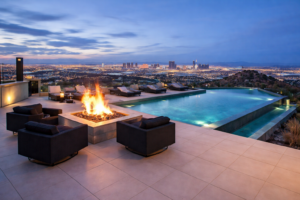
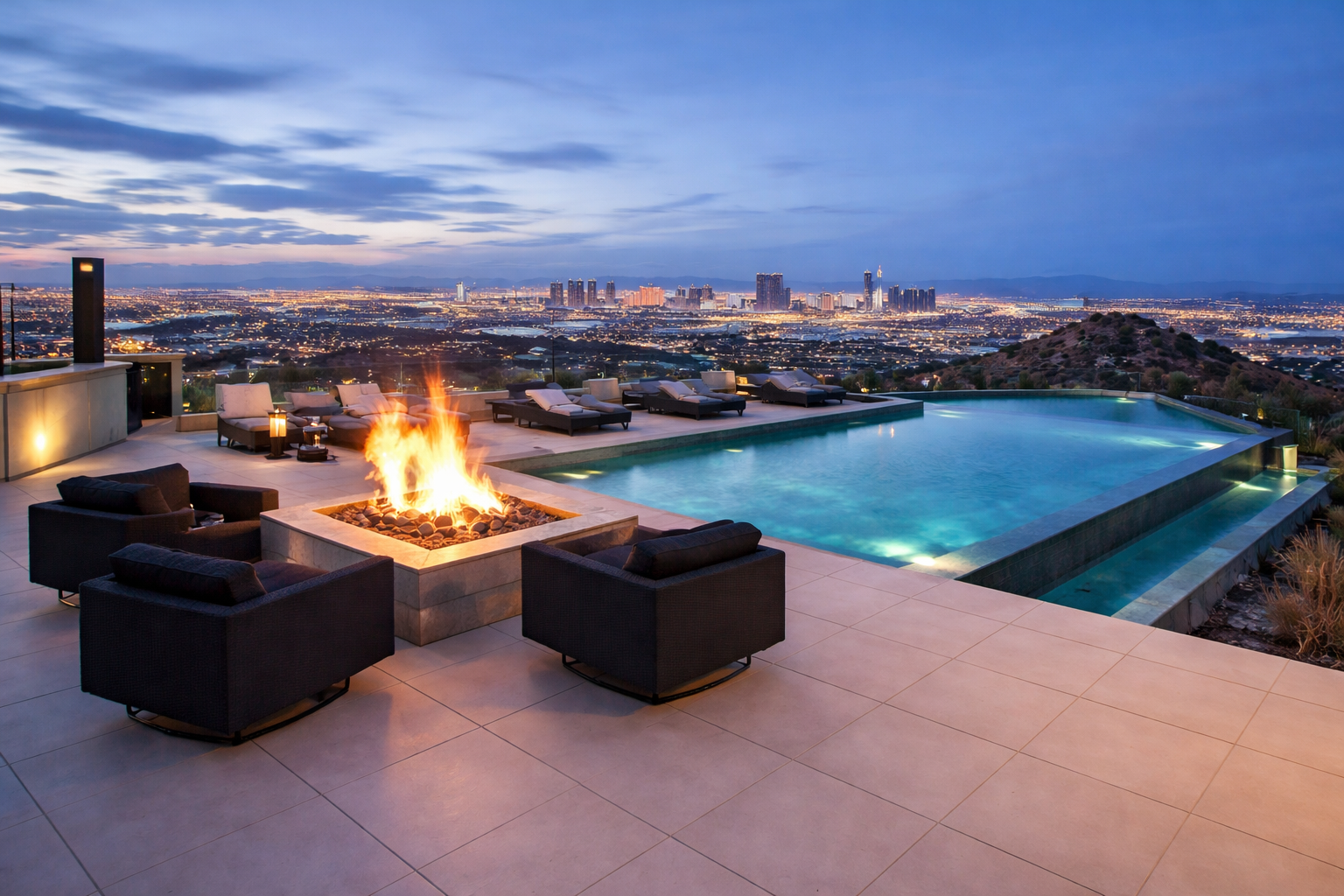
Landscaping and outdoor living. Pools, water features, and outdoor entertainment spaces remain highly desirable in Las Vegas luxury. However, buyers and appraisers are increasingly attentive to water-efficient design. Properties with smart irrigation, drought-tolerant landscaping, and modern pool systems are better positioned than those requiring significant water retrofitting.
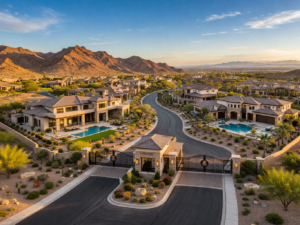
HOA and municipal water costs. In guard-gated communities, water costs and landscaping assessments are coming under greater scrutiny. Buyers doing serious due diligence are reviewing HOA financials with water expenses in mind.
Future development and supply. Water availability indirectly constrains new luxury development in the Southwest. In markets where water allocations are tightening, new construction becomes harder to permit — which protects the value of existing luxury inventory. Las Vegas, with its established water rights framework, is better insulated from this dynamic than many competing markets.
Relocation patterns. High-net-worth individuals leaving California — particularly from water-stressed areas like the Central Valley and parts of Southern California — are increasingly factoring water security into their destination decisions. Nevada’s track record on conservation and infrastructure management is a selling point that sophisticated buyers recognize.
WHAT CURRENT HOMEOWNERS SHOULD KNOW
If you own luxury property in Las Vegas, the drought conversation is largely working in your favor. Your market is better managed, better positioned, and better regulated around water than most of its Southwest competitors.
That said, it’s worth auditing your property’s water systems — irrigation controllers, pool equipment, and landscaping — both to reduce costs and to ensure the property presents well to the increasingly water-conscious buyer pool. A home that demonstrates thoughtful water management is a stronger asset in today’s market.
WHAT BUYERS AND INVESTORS SHOULD KNOW
Water rights, municipal water sources, and long-term supply projections are now legitimate due diligence items for any significant real estate purchase in the Southwest. Before committing to a luxury property in any desert market, understand where the water comes from, what the long-term outlook is, and what conservation obligations apply to the property.
In Las Vegas, those answers are more reassuring than in most comparable markets. But the question is worth asking everywhere.
THE BOTTOM LINE
Water is the new school district. It’s the infrastructure variable that sophisticated buyers are beginning to factor into long-term real estate decisions in ways they simply didn’t five years ago. Lake Mead is under serious pressure — and 2026 is not a year to look away from that reality. But Las Vegas, counterintuitively, is one of the best-positioned luxury markets in the Southwest on this dimension — built on decades of conservation policy, water recycling infrastructure, and responsible management that most competing markets simply haven’t matched.
If you want to talk through how water, infrastructure, and long-term value intersect in your specific situation — whether you’re buying, selling, or evaluating your current position — I’d welcome that conversation.